
A bridge from Main Street to Wall Street.
The Main Street Growth Act will allow for the creation of “venture exchanges.”
These specialized exchanges will help small and emerging growth companies gain access to the capital they need to grow and succeed.
The small IPO decline.
Today, the US has fewer than half of the number of publicly-listed companies than two decades ago. Small-company initial public offerings (”IPOs”) are virtually nonexistent.
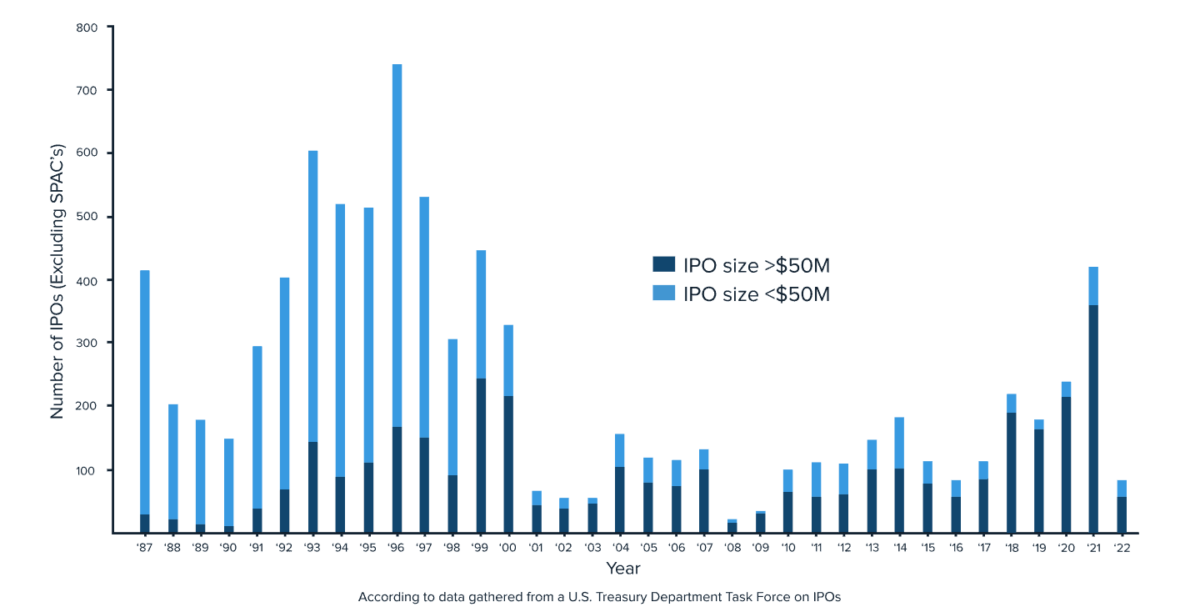

Why did this happen?
Since 1998 the collapse of the small capital IPO correlates to the expansion of high-frequency electronic stock exchanges. While these electronic exchanges help optimize trading for large companies, small companies lack the volume and liquidity to maintain constant trading transactions.
Harmful effects
Investor Access
Today, small capital markets operate primarily as private networks where access and information flow primarily among industry insiders, early highly capitalized investors (such as angel investors) and venture capital firms—capturing the earliest and most substantial rewards of company growth before public offerings become available.
Job Growth
Following October 20, 2011, S.E.C. IPO On-Ramp Task Force’s report, on average 92% of all jobs within a company are created after the company goes public. Increasing the number of small to mid-sized IPOs means that there will be more opportunities in the job market for their employees to thrive.
Wealth Creation
Small and mid-sized business owners, investors, and employees face limited opportunities to build wealth under the current market structure.
Company Access
The small company initial public offering (IPO) market has significantly declined. Specifically, firms with the last twelve months of sales pre-IPO being less than $50 million (small IPOs) are reported to experience a significant drop. During the time period from 1980-2000, small IPOs constituted 53% of the entire IPO market. In stark contrast, small IPOs only constituted 28% during the time period from 2001 to 2012 (Gao, Ritter and Zhu, Journal of Financial and Quantitative Analysis, 2013). The study posited that selling to a larger corporation offered significant economies of scope and led to the considerable decrease of small IPOs. In a related study, during the time period from 1997 to 2012, the number of exchange-listed IPOs with market capitalization at the IPO stage less than $75 million, dropped from 168 to seven (Rose and Solomon, Harvard Business Law Review, 2016). High regulatory costs, reduced analyst coverage and volatility and liquidity concerns have been cited as alternative reasons for the small cap IPOs decline in recent years.

Our Solution
Rebuilding the IPO on-ramp.
Once the Main Street Growth Act is passed and allow for the creation of venture exchanges, smaller companies with a purpose will be able to list and actively trade their securities in this new market. Venture exchanges can serve as small company incubators and create additional incentives that are currently available for the better capitalized companies in the public markets, such as aggregated liquidity, regulatory oversight, customized auctions and tick sizes; and transparent reporting.
More Information
The Main Street Growth Act
Venture Exchanges: Executive Summary
Download
Please fill out the below form to download this document.
"*" indicates required fields
Frequently Asked Questions
Can the Dream Exchange open without the Main Street Growth Act?
Yes, the Dream Exchange intends to open a fully licensed National Market System Stock Exchange similar to the NASDAQ and NYSE which requires no legislation to open.
Concurrently, Dream Exchange continues to champion the Main Street Growth Act which will allow for the creation of venture exchanges which will list and trade early-stage, small-to-mid sized businesses.
What is a venture exchange?
A venture exchange is a brand-new type of stock exchange that is currently pending legislation in the U.S. Congress. Once created, venture exchanges will expand the auction style stock exchange environment to small-to-mid sized companies, providing access to investment, liquidity, transparency, and improved regulation in this new marketplace.
When will the venture exchange be open?
In order to create the first venture exchange, a new piece of legislation called the Main Street Growth Act must be passed. Once enacted, the Main Street Growth Act will allow for venture exchanges to exist.
How do I invest in companies on the Venture Exchange?
Dream Exchange is not currently operational as a venture exchange. More information about the process to begin investing in listed companies on our venture exchange will be published after the Main Street Growth Act is passed, we are licensed.
Please fill out the form below to be notified about milestones in our progress toward opening.
How do I list my company on the venture exchange?
Dream Exchange is not currently operational as a stock exchange. Once the Main Street Growth Act passes and we apply for and acquire a license to operate a venture exchange, we will be issuing more information about this process.
Please fill out the form below to be kept abreast of all news related to this milestone.
What types of companies will Dream Exchange list?
Dream Exchange will focus on expanding listings in the national market system to include smaller companies with a concentration on underserved markets especially those with innovative products and services.
Our listing platform will align with our Company’s goals: to help capital formation for companies with products that increase our ability to survive and flourish on our planet.
Please fill out the form below to be kept abreast of all news related to this milestone.